Grid 101: Transmission 1#
While we may think that the power lines that provide the backdrop scenery to any modern city are uniform, there is a major difference between those that support electricity transmission and those that are used for distribution. For starters, transmission lines are generally much, much larger, while distribution lines are what we are used to seeing lining our city streets on wooden poles. But what else differentiates the two?
What is the difference between transmission lines and distribution lines on the energy grid?
While transmission lines are meant for transporting energy across a very great distance, distribution lines are for local energy distribution. Utilities are able to manipulate the relationship between voltage and current using transformers to “step-up” and “step-down” voltage. Due to the special relationship between voltage and current, when a ‘step-up transformer’ increases voltage, current subsequently decreases. Whenever we transmit energy, some of that energy is lost due to inefficiency and dissipates as heat. This makes high-voltage optimal for transporting electricity across long distances, since high voltage transmission loses less electricity through this heat dissipation. In fact, in the US, we lose about 6% of our energy through heat loss. (UCSUCA)
Alternatively, high-current transmission is much more dangerous than high voltage and would require very thick, heavy transmission lines. Furthermore, the standard distance between two transmission lines is about 300 miles. These costs would add up quickly and create a much less efficient system, so high current transmission is not feasible for industrial scale projects.
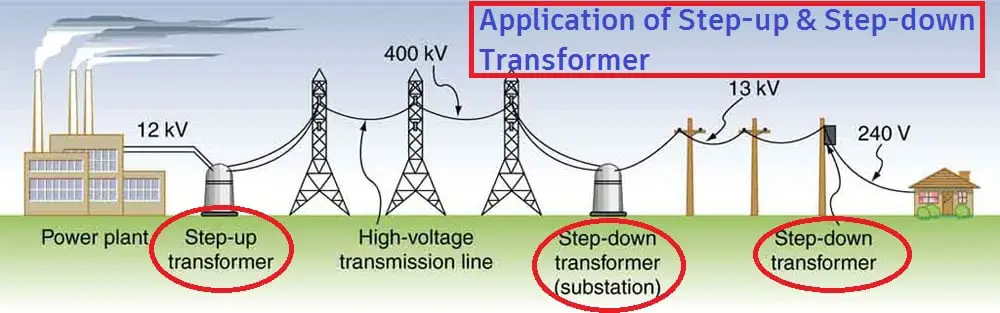
Once electricity is transported across high-voltage transmission lines, the voltage must be “stepped-down” with another transformer before it can be distributed through the local grid. This takes our voltage from 400,000 volts down to around 13,000 volts. However, before this electricity is used in our homes it must be stepped-down again to just 240 volts. The step-up and step-down transformers are primary components of substations, which are commonly seen in any modern city, even in residential areas. Substations are gated hubs of switches, transformers, and control units; when you see an ominous “high-voltage, keep out!” sign, there is a good chance that you are probably looking at a substation!
Within the substation, the key action performed is the step-up and step-down functionality.