Intro#
Intro to the Grid: Grid Overview
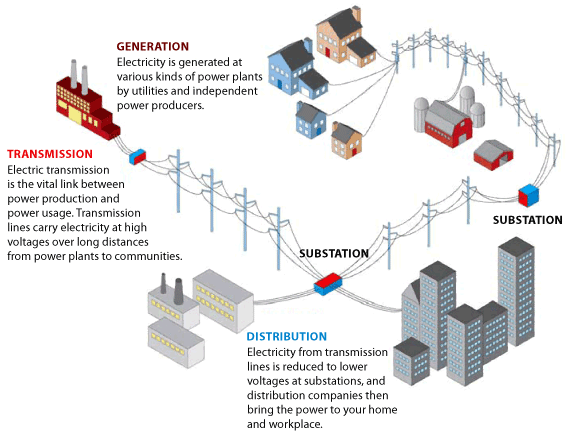
The following series of blogs will address how electricity is generated, the path it takes to our home, the sensors that monitor it, and the various political and private entities that govern it. To offer a brief overview, electricity is generated when a magnet excites a conductive material in such a way that the electrons around its atoms are excited. Energy is first generated then transmitted over long distances before it is distributed locally. This electricity is usually in the form of three phase AC current, traditionally generated by circular motion that comes from hot steam turning a turbine. When this turbine spins, the energy is harnessed to rotate a magnet, which in turn excites electrons and generates electricity. This steam is usually powered by non-renewable sources such as coal and natural gas. In the process of transportation, some energy will always dissipate as heat, which can be minimized through high voltage conversion for long distance transmission. This conversion requires step-up transformers to increase the voltage and decrease the current before transmission, and then another step-down transformer after transmission to return the electricity to a usable, lower voltage.
As energy flows through the grid, sensors are used to monitor the electricity. SCADA is an older, established system that is very prevalent in monitoring and control applications. Recently, utilities have adopted synchrophasors (also known as PMUs) to monitor the grid with greater clarity. Finally, continuous point on wave data (CPOW) allows for the most accurate grid sensor data.
The grid is largely controlled by large electric utility providers either investor owned or else public utilities. On top of this, Independent System Operators (ISOs) are neutral parties that govern transmission over a wide area such as a state, while Regional Transmission Operators (RTOs) cover a much larger area, such as multiple states. These exist at the recommendation of the Federal Energy Regulatory Commission or FERC, and governed by the North American Energy Reliability Council (NERC).
While most of our energy is generated from non-renewable sources, renewable alternatives are quickly increasing their share of our energy generation mix. While renewables are better for reducing greenhouse gas emissions, they complicate the grid as they are distributed throughout the grid as opposed to localized in the case of a traditional generation source. All of this new energy flowing into the grid from many directions, such as solar panels on a residential home with excess energy, creates a more complicated grid. Through more advanced monitoring, we can better understand the grid with greater detail. This detail enables the data revolution occurring in the grid space and allows us to better understand the implications of connecting distributed energy resources like hydropower, wind turbines, and solar throughout the grid. Since our grid has aged, the massive influx of new technology and great adoption of data makes this a very exciting time to study the development of our grid.